Reciprocity
| Encyclopedia of Terminology for CA and IL: Reciprocity | |
|---|---|
| Author(s): | Jakub Mlynář (HES-SO Valais-Wallis University of Applied Sciences and Arts Western Switzerland, Switzerland) (https://orcid.org/0000-0001-5206-3212) & Yeji Rieser (University of Basel, Switzerland) (https://orcid.org/0000-0002-6582-150X) |
| To cite: | Mlynář, Jakub, & Rieser, Yeji. (2026). Reciprocity. In Alexandra Gubina, Elliott M. Hoey & Chase Wesley Raymond (Eds.), Encyclopedia of Terminology for Conversation Analysis and Interactional Linguistics. International Society for Conversation Analysis (ISCA). DOI: https://doi.org/10.17605/OSF.IO/2PYH7 |
The term reciprocity is used in a wide variety of ways – addressing a prerequisite for social interaction; referring to the sequential production of relevant next actions; as well as describing phenomena implicating processes of mutual exchange (literally or metaphorically). Reciprocity is taken to be a fundamental precondition of sociality and an assumption for its analytical grasp, but also a produced phenomenon of order.
Schutz’s (1962) notion of “reciprocity of perspectives” was part of his attempt to explain how phenomenology can move from an individual consciousness to the social world. In his view, two basic idealizations of common-sense thinking overcome the asymmetrical access to knowledge about the world and the differences in our personal backgrounds: (1) the interchangeability of the standpoints, and (2) the congruency of the system of relevances. In other words, one takes for granted that if one were to exchange positions with another person, they would perceive things in the same way, and the other takes this for granted too. Furthermore, one also takes for granted that the manner in which one perceives things does not depend on any unique personal characteristics that are not relevant for the practical purposes at hand, and the other person takes this for granted too. From the perspective of ethnomethodology and CA, reciprocity is not just a given assumption or an abstract principle which makes social interaction possible. Instead, it is reflexively achieved in the very ways in which members make sense of and make recognizable their actions to one another such that they can engage in concerted activities, each and every time, in their local and practical circumstances (Mair, 2025). The Schutzian conception was, in different ways, an inspiration for early ethnomethodology (Cicourel, 1974; Garfinkel, 1963) and occasionally appears in more recent studies. For example, following Garfinkel (1963), Rawls and David (2006) use the notion of “(mutual) reciprocity” mostly as a synonym or proxy for “trust”. Vom Lehn (2019), in a video-based CA study, refers to Schutz in his analysis of performing optometric tests where the visual perspective of the currently assessed client is measurably interchangeable with that of a standardized client.
Nevertheless, in more recent works, the phenomenological notion of “reciprocity of perspectives” seems to be more often elaborated under the rubric of “intersubjectivity” (e.g., Deppermann, 2015) and as providing a historical background for the conception of sequentiality: Goodwin and Heritage (1990) describe adjacency pair organization as a “framework of reciprocal conduct” where “[e]ach participant must analyze the developing course of others’ actions in order to produce appropriate reciprocal action” (p. 288). In this sense, reciprocity is accountable in the details of the timely and adequate production of a second-pair part in response to a first-pair part – for example, a greeting (e.g., “Hello”) is routinely responded to with a reciprocal greeting. The greeting is not always composed of a single turn-constructional unit (TCU) but can also consist of a “how are you” which opens a sequence in itself to be responded to with a second-pair part and also reciprocated through the initiation of a second sequence. When it comes to these greeting sequences, what Schegloff (2007) calls “reciprocal or exchange sequences” (pp. 195–207), he observes that the reciprocal nature of the second sequence is accountable in the design of the turn, e.g., “how about you” instead of a verbatim repeat of “how are you.” Therefore, the accountability of a second sequence as a reciprocal does not depend on its temporally successive position per se but is a produced order by the participants. Moreover, Schegloff (2007) notes that while such sequences are routinely done reciprocally, their relevance is worked out in local circumstances where sometimes, e.g., depending on categorial memberships and/or specific institutional settings, it is more relevant to not reciprocate such sequences. This is what Albert and Raymond (2019) illustrate in their analysis of the US president Trump’s greeting sequences with multiple recipients in succession.
(1) [Video available here] (Albert & Raymond, 2019: 72)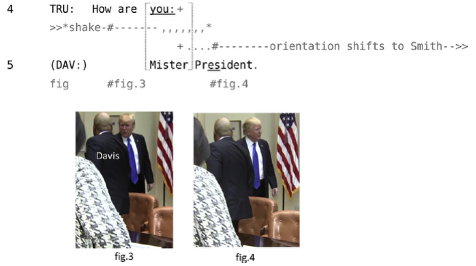

In this stage-managed situation, the authors point out that the recipients do not orient to reciprocating the greeting sequence nor does Trump himself anticipate one. The non-reciprocity of the greeting sequence is reciprocally coordinated in the way by which the recipient’s response is minimally produced, and Trump, already during this response, moves on to greeting the next person in line. Beyond human communication, “interactional reciprocity” has also been studied in human–dog interactions, suggesting that dogs orient to the lack of reciprocity from their owners in terms of a missing next action and employ a set of practices to pursue it (Simonen & Lohi, 2021).
Turning to the most literal sense of the term, the following example is taken from a study that belongs to a rather small number of texts that treat “reciprocity” as a phenomenon in its own right, i.e., as a transactional process of giving and taking. Llewellyn (2011) analyses the phenomenon of “picking up the bill” as a case of a gift exchange where the benefactor and the beneficiary orient to the norm of reciprocity. The data comes from video-recordings of a payment desk at a gallery where customers approach to pay for tickets. In Extract II below, two customers (C1, C2) approach the desk to buy tickets. The focus is on how C1 accounts for her acceptance of C2 picking up the bill by offering a reciprocation in response (cf. Clayman & Heritage, 2014, on reciprocations by beneficiaries as a type of appreciative response).
(2) (Llewellyn, 2011: 729)
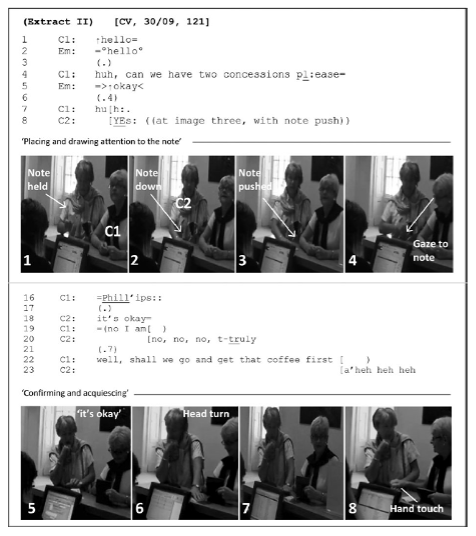

At the desk, while it is C1 who verbalizes the request to the staff, it is C2 who is quicker to prepare the 20 dollar note to pay (lines 1–8). The possibility that this could be C2 “picking up the bill” is not immediately accepted by C1 who, during the omitted lines (lines 9–15), engages in an interaction with the staff and proceeds to pay her own sum. It is at this point that C2, in line 18, further advances the note on the desk to a space where the staff can readily take it. Thus, C2 accountably produces the action of “picking up the bill” which C1 ultimately accepts with an expression of gratitude such as by gazing at her and touching her hand. At this sequential position, C1 suggests that they get coffee (line 22) as a way of accounting for her acceptance by means of invoking the norm of reciprocity – i.e., since C2 has given her the gift of picking up the bill, she will return it in the form of buying coffee. Although the excerpt focuses on the phenomenon of reciprocity as a norm invoked in gift exchange sequences, it also illustrates the two earlier notions of reciprocity at work. The very intelligibility of any action – greetings, offers, requests, “drawing attention to the note”, etc. – relies on the reciprocity of perspectives being taken for granted by the participants, and is achieved in the appropriate sequential positioning of embodied conduct.
Additional Related Entries:
Cited References:
Albert, S. & Raymond, C. W. (2019). Conversation analysis at the ‘middle region’ of public life: Greetings and the interactional construction of Donald Trump's political persona. Language & Communication, 69, 67–83.
Cicourel, A. V. (1974). Cognitive Sociology: Language and Meaning in Social Interaction. Penguin.
Clayman, S. E. & Heritage, J. (2014). Benefactors and beneficiaries: Benefactive status and stance in the management of offers and requests. In P. Drew & E. Couper-Kuhlen (Eds.), Requesting in Social Interaction (pp. 55–86). John Benjamins.
Deppermann, A. (2015). When recipient design fails: Egocentric turn-design of instructions in driving school lessons leading to breakdowns of intersubjectivity. Gesprächsforschung: Online-Zeitschrift zur verbalen Interaktion, 16, 63–101.
Garfinkel, H. (1963). A conception of, and experiments with, “trust” as a condition of stable concerted actions. In O. J. Harvey (Ed.), Motivation and Social Interaction: Cognitive Determinants (pp. 187–238). Ronald Press.
Goodwin, C. & Heritage, J. (1990). Conversation analysis. Annual Review of Anthropology, 19, 283–307.
Llewellyn, N. (2011). The gift in interaction: a study of “picking-up the bill”. British Journal of Sociology, 62(4), 718–738.
Mair, M. (2025). Editorial: Ethnomethodological readings of philosophy, social theory, and the social sciences. In A. P. Carlin, A. Dennis, K. N. Jenkings, O. Lindwall & M. Mair (Eds.), The Routledge International Handbook of Ethnomethodology (pp. 91–103). Routledge.
Rawls, A. W. & David, G. C. (2005). Accountably other: Trust, reciprocity, and exclusion in a context of situated practice. Human Studies, 28(4), 469–497.
Schegloff, E. A. (2007). Sequence Organization in Interaction: A Primer in Conversation Analysis. Cambridge University Press.
Simonen, M., & Lohi, H. (2021). Interactional reciprocity in human–dog interaction. In J. Lindström, R. Laury, A. Peräkylä & M.-L. Sorjonen (Eds.), Intersubjectivity in Action: Studies in Language and Social Interaction (pp. 397–428). John Benjamins.
vom Lehn, D. (2019). From Garfinkel’s ‘experiments in miniature’ to the ethnomethodological analysis of interaction. Human Studies, 42(2), 305–326.


