Difference between revisions of "Indexing"
ChaseRaymond (talk | contribs) (Created page with "{{Infobox cite | Authors = '''John Heritage''' (UCLA, USA) (https://orcid.org/0000-0002-8603-6447) | To cite = Heritage, John. (2026). Epistemics. In Alexandra Gubina, Elliot...") |
ChaseRaymond (talk | contribs) |
||
| (7 intermediate revisions by the same user not shown) | |||
| Line 1: | Line 1: | ||
{{Infobox cite | {{Infobox cite | ||
| − | | Authors = ''' | + | | Authors = '''Jakub Mlynář''' (HES-SO Valais-Wallis University of Applied Sciences and Arts Western Switzerland, Switzerland) (https://orcid.org/0000-0001-5206-3212) |
| − | | To cite = | + | | To cite = Mlynář, Jakub. (2026). Indexing. In Alexandra Gubina, Elliott M. Hoey & Chase Wesley Raymond (Eds.), ''Encyclopedia of Terminology for Conversation Analysis and Interactional Linguistics''. International Society for Conversation Analysis (ISCA). DOI: [ ] |
}} | }} | ||
The verb '''indexing''' is used to encompass relationships between observable phenomena and their directly unobservable correlates. The term is used in analyses of particular features of data under examination, and signposts that a feature – e.g., an uttered phrase or a type of produced gesture – makes relevant an analytical orientation to a background structure. Thus, in line with a broader sociolinguistic perspective, “meaning [is] indexed by linguistic structures” (Ochs 1992: 228). Taking this orientation, contemporary studies in IL and CA attended to, for example, how turn-final ''or'' indexes uncertainty (Drake 2015) and ''do''-constructions index contrast (Raymond 2017) in English, how ''ich dachte'' indexes discrepant assumptions (Depperman & Reineke 2020) and responsive ''(das) stimmt'' indexes a change in epistemic access (Betz 2015) in German, and how the Danish token ''n↑å↓'' indexes a perceptual shift after periods of intense scrutiny (Heinemann 2016). | The verb '''indexing''' is used to encompass relationships between observable phenomena and their directly unobservable correlates. The term is used in analyses of particular features of data under examination, and signposts that a feature – e.g., an uttered phrase or a type of produced gesture – makes relevant an analytical orientation to a background structure. Thus, in line with a broader sociolinguistic perspective, “meaning [is] indexed by linguistic structures” (Ochs 1992: 228). Taking this orientation, contemporary studies in IL and CA attended to, for example, how turn-final ''or'' indexes uncertainty (Drake 2015) and ''do''-constructions index contrast (Raymond 2017) in English, how ''ich dachte'' indexes discrepant assumptions (Depperman & Reineke 2020) and responsive ''(das) stimmt'' indexes a change in epistemic access (Betz 2015) in German, and how the Danish token ''n↑å↓'' indexes a perceptual shift after periods of intense scrutiny (Heinemann 2016). | ||
| − | One of the earliest uses of the term in CA-adjacent discourse can be found in Erving Goffman’s ''Forms of Talk'' (1981), who discusses '''response cries''' – in a text first published in 1978 – as possibly belonging to a category of “signs meant to be taken to index directly the state of the transmitter” (Goffman 1981: 116) – namely states such as “feelings” (ibid., p. 20) and other “psychic states” (ibid., p. 111). Note that according to Goffman the indexing of inner states is both intentionally produced by the speaker (“meant”) and interpreted by the hearer (“taken”) but is still relatively “direct” in the case of response cries. This might not be so with other practices that have been studied in CA and IL. Heritage (1984) referred to and appropriated Goffman’s (1981) use of the term in his early discussion of ''oh'' as a '''change-of-state token''' – as Koivisto (2023) briefly puts it, “''oh'' indexes a change in state”. Similarly, in a later study by Heritage and Raymond (2005), specific formats of talk-in-interaction – produced and made sense of in the particulars of the sequential environment – are proposed to be indexing epistemic authority (see also Wu 2018). | + | One of the earliest uses of the term in CA-adjacent discourse can be found in Erving Goffman’s ''Forms of Talk'' (1981), who discusses '''[[Response cry|response cries]]''' – in a text first published in 1978 – as possibly belonging to a category of “signs meant to be taken to index directly the state of the transmitter” (Goffman 1981: 116) – namely states such as “feelings” (ibid., p. 20) and other “psychic states” (ibid., p. 111). Note that according to Goffman the indexing of inner states is both intentionally produced by the speaker (“meant”) and interpreted by the hearer (“taken”) but is still relatively “direct” in the case of response cries. This might not be so with other practices that have been studied in CA and IL. Heritage (1984) referred to and appropriated Goffman’s (1981) use of the term in his early discussion of ''oh'' as a '''[[Change-of-state token|change-of-state token]]''' – as Koivisto (2023) briefly puts it in the associated Encyclopedia entry, “''oh'' indexes a change in state”. Similarly, in a later study by Heritage and Raymond (2005), specific formats of talk-in-interaction – produced and made sense of in the particulars of the sequential environment – are proposed to be indexing '''[[Epistemic Authority|epistemic authority]]''' (see also Wu 2018). |
To illustrate the purpose of the term, consider the following transcript from a paper by Kaneyasu and Iwasaki (2017) on indexing “entrustment” based on a social relationship or a shared cultural knowledge. The authors argue that the Japanese formulaic construction ''N da yo N'' “foregrounds and takes advantage [of entrustment] in order to reaffirm a close mutual relationship” (p. 417). The excerpt reproduced below is from a movie ''Zatoichi''. | To illustrate the purpose of the term, consider the following transcript from a paper by Kaneyasu and Iwasaki (2017) on indexing “entrustment” based on a social relationship or a shared cultural knowledge. The authors argue that the Japanese formulaic construction ''N da yo N'' “foregrounds and takes advantage [of entrustment] in order to reaffirm a close mutual relationship” (p. 417). The excerpt reproduced below is from a movie ''Zatoichi''. | ||
| Line 14: | Line 14: | ||
(Shin (a male) and Osei (a male disguised as a female) are facing each other in a small bath tub.) | (Shin (a male) and Osei (a male disguised as a female) are facing each other in a small bath tub.) | ||
| − | [[File:Mlynar indexing fig1.png | + | [[File:Mlynar indexing fig1.png]] |
In this movie scene, Shinkichi admires Kiyotaroo’s disguise as Osei, attributing the beauty to the use of makeup. Osei partially disagrees, stressing that true beauty comes from natural facial features (line 7). The authors propose that the common knowledge being indexed here by the ''N da yo N'' construction is that “the natural features of one’s face are considered crucial to how beautiful the person would look with makeup” (p. 412). The linguistic construction thus obtains its meaning in and through its reference to an underlying structure – in this instance, to the relevant common knowledge and entrustment that is being expressed or indexed using the formulaic phrase. | In this movie scene, Shinkichi admires Kiyotaroo’s disguise as Osei, attributing the beauty to the use of makeup. Osei partially disagrees, stressing that true beauty comes from natural facial features (line 7). The authors propose that the common knowledge being indexed here by the ''N da yo N'' construction is that “the natural features of one’s face are considered crucial to how beautiful the person would look with makeup” (p. 412). The linguistic construction thus obtains its meaning in and through its reference to an underlying structure – in this instance, to the relevant common knowledge and entrustment that is being expressed or indexed using the formulaic phrase. | ||
| − | The term indexing as employed in CA and IL also became a subject of discussion in the context of '''epistemics''' (e.g., Macbeth et al., 2016; Heritage, 2018, 2024; Button et al. 2022). One distinction often noted in this debate is the difference between indexing and '''indexicality'''. While the notion of indexicality specifically avoids attributing ‘meaning’ to ‘signed objects’ (such as turns at talk), the notion of indexing has been linked to Peirce’s (see Burks 1949) original concept of “indexes” as a category of signs (alongside “icons” and “symbols”). | + | The term indexing as employed in CA and IL also became a subject of discussion in the context of '''[[Epistemics|epistemics]]''' (e.g., Macbeth et al., 2016; Heritage, 2018, 2024; Button et al. 2022). One distinction often noted in this debate is the difference between indexing and '''[[Indexicality|indexicality]]'''. While the notion of indexicality specifically avoids attributing ‘meaning’ to ‘signed objects’ (such as turns at talk), the notion of indexing has been linked to Peirce’s (see Burks 1949) original concept of “indexes” as a category of signs (alongside “icons” and “symbols”). |
| Line 24: | Line 24: | ||
* '''[[change-of-state token]]''' | * '''[[change-of-state token]]''' | ||
| − | * '''[[ | + | * '''[[epistemics]]''' |
| − | * '''[[ | + | * '''[[epistemic authority]]''' |
| − | * '''[[ | + | * '''[[epistemic stance]]''' |
| − | * '''[[ | + | * '''[[indexicality]]''' |
'''Cited References:''' | '''Cited References:''' | ||
| − | + | Betz, E. M. (2015). Indexing epistemic access through different confirmation formats: Uses of responsive ''(das) stimmt'' in German interaction. ''Journal of Pragmatics'', 87, 251–266. | |
| − | + | Burks, A. W. (1949). Icon, Index, and Symbol. ''Philosophy and Phenomenological Research'', 9(4), 673–689. | |
| − | + | Button, G., Lynch, M., & Sharrock, W. (2022). ''Ethnomethodology, Conversation Analysis and Constructive Analysis: On Formal Structures of Practical Action''. Routledge. | |
| − | + | Deppermann, A., & Reineke, S. (2020). Practices of indexing discrepant assumptions with German ich dachte (‘I thought’) in talk-in-interaction. ''Functions of Language'', 27(2), 113–142. | |
| − | |||
| − | + | Drake, V. (2015). Indexing uncertainty: The case of turn-final ''or''. ''Research on Language and Social Interaction'', 48(3), 301–318. | |
| − | + | Goffman, E. (1981). ''Forms of Talk''. Basil Blackwell. | |
| − | + | Heinemann, T. (2016). From ‘looking’ to ‘seeing’: Indexing delayed intelligibility of an object with the Danish change-of-state token ''n↑å↓:''. ''Journal of Pragmatics'', 104, 108–132. | |
| − | + | Heritage, J. (1984). A change-of-state token and aspects of its sequential placement. In J. M. Atkinson & J. Heritage (Eds.), ''Structures of Social Action: Studies in Conversation Analysis'' (pp. 299–345). Cambridge University Press. | |
| − | |||
| − | + | Heritage, J. (2018). The ubiquity of epistemics: A rebuttal to the ‘epistemics of epistemics’ group. ''Discourse Studies'', 20(1), 14–56. | |
| − | + | Heritage, J. (2024). The epistemics of epistemics: Validating claims about epistemic stance in conversation analysis. In J. D. Robinson, R. Clift, K. H. Kendrick, & C. W. Raymond (Eds.), ''The Cambridge Handbook of Methods in Conversation Analysis'' (pp. 419–451). Cambridge University Press. | |
| − | + | Heritage, J., & Raymond, G. (2005). The terms of agreement: Indexing epistemic authority and subordination in assessment sequences. ''Social Psychology Quarterly'', 68(1), 15–38. | |
| − | + | Koivisto, A. (2023). Change-of-state token. In A. Gubina, E. M. Hoey & C. W. Raymond (Eds.), ''Encyclopedia of Terminology for Conversation Analysis and Interactional Linguistics''. International Society for Conversation Analysis (ISCA). | |
| − | + | Macbeth, D., Wong, J., & Lynch, M. (2016). The story of ‘Oh’, Part 1: Indexing structure, animating transcript. ''Discourse Studies'', 18(5), 550–573 | |
| − | + | Ochs, E. (1992). Indexing gender. In A. Duranti & C. Goodwin (Eds.), ''Rethinking Context: Language as an Interactive Phenomenon'' (pp. 335–358). Cambridge University Press. | |
| − | + | Raymond, C. W. (2017). Indexing a contrast: The ''do''-construction in English conversation. ''Journal of Pragmatics'', 118, 22–37. | |
| − | + | Wu, R.-J. R. (2018). Indexing epistemic authority/primacy in Mandarin conversation: ''aiyou''-prefacing as an interactional resource. ''Journal of Pragmatics'', 131, 30–53. | |
| − | |||
| − | |||
| − | |||
| − | |||
| − | |||
| − | |||
| − | |||
| − | |||
| − | |||
| − | |||
| − | |||
| − | |||
| − | |||
| − | |||
| − | |||
| − | |||
| − | |||
| − | |||
| − | |||
| − | |||
| − | |||
| − | |||
| − | |||
| − | |||
| − | |||
| − | |||
| − | |||
| − | |||
| − | |||
| − | |||
| − | |||
| − | |||
| − | |||
| − | |||
| − | |||
| − | |||
| − | |||
| − | |||
| − | |||
| − | |||
| − | |||
| − | |||
| − | |||
| − | |||
| − | |||
| − | |||
| − | |||
| − | |||
| − | |||
| − | |||
| − | |||
| − | |||
| − | |||
| − | |||
| − | |||
| − | |||
| − | |||
| − | |||
| − | |||
| − | |||
| − | |||
| − | |||
| − | |||
| − | |||
| − | |||
| − | |||
| − | |||
| − | |||
| − | |||
| − | |||
Latest revision as of 23:50, 1 September 2026
| Encyclopedia of Terminology for CA and IL: Indexing | |
|---|---|
| Author(s): | Jakub Mlynář (HES-SO Valais-Wallis University of Applied Sciences and Arts Western Switzerland, Switzerland) (https://orcid.org/0000-0001-5206-3212) |
| To cite: | Mlynář, Jakub. (2026). Indexing. In Alexandra Gubina, Elliott M. Hoey & Chase Wesley Raymond (Eds.), Encyclopedia of Terminology for Conversation Analysis and Interactional Linguistics. International Society for Conversation Analysis (ISCA). DOI: [ ] |
The verb indexing is used to encompass relationships between observable phenomena and their directly unobservable correlates. The term is used in analyses of particular features of data under examination, and signposts that a feature – e.g., an uttered phrase or a type of produced gesture – makes relevant an analytical orientation to a background structure. Thus, in line with a broader sociolinguistic perspective, “meaning [is] indexed by linguistic structures” (Ochs 1992: 228). Taking this orientation, contemporary studies in IL and CA attended to, for example, how turn-final or indexes uncertainty (Drake 2015) and do-constructions index contrast (Raymond 2017) in English, how ich dachte indexes discrepant assumptions (Depperman & Reineke 2020) and responsive (das) stimmt indexes a change in epistemic access (Betz 2015) in German, and how the Danish token n↑å↓ indexes a perceptual shift after periods of intense scrutiny (Heinemann 2016).
One of the earliest uses of the term in CA-adjacent discourse can be found in Erving Goffman’s Forms of Talk (1981), who discusses response cries – in a text first published in 1978 – as possibly belonging to a category of “signs meant to be taken to index directly the state of the transmitter” (Goffman 1981: 116) – namely states such as “feelings” (ibid., p. 20) and other “psychic states” (ibid., p. 111). Note that according to Goffman the indexing of inner states is both intentionally produced by the speaker (“meant”) and interpreted by the hearer (“taken”) but is still relatively “direct” in the case of response cries. This might not be so with other practices that have been studied in CA and IL. Heritage (1984) referred to and appropriated Goffman’s (1981) use of the term in his early discussion of oh as a change-of-state token – as Koivisto (2023) briefly puts it in the associated Encyclopedia entry, “oh indexes a change in state”. Similarly, in a later study by Heritage and Raymond (2005), specific formats of talk-in-interaction – produced and made sense of in the particulars of the sequential environment – are proposed to be indexing epistemic authority (see also Wu 2018).
To illustrate the purpose of the term, consider the following transcript from a paper by Kaneyasu and Iwasaki (2017) on indexing “entrustment” based on a social relationship or a shared cultural knowledge. The authors argue that the Japanese formulaic construction N da yo N “foregrounds and takes advantage [of entrustment] in order to reaffirm a close mutual relationship” (p. 417). The excerpt reproduced below is from a movie Zatoichi.
(1) Face (film 'Zatoichi', 2003)

(Shin (a male) and Osei (a male disguised as a female) are facing each other in a small bath tub.)
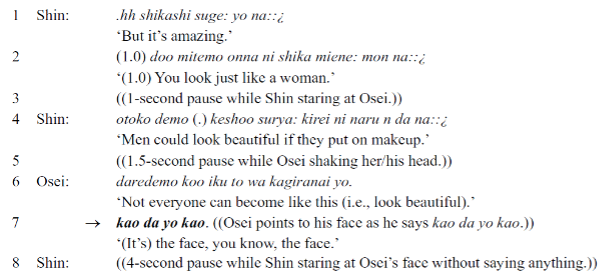

In this movie scene, Shinkichi admires Kiyotaroo’s disguise as Osei, attributing the beauty to the use of makeup. Osei partially disagrees, stressing that true beauty comes from natural facial features (line 7). The authors propose that the common knowledge being indexed here by the N da yo N construction is that “the natural features of one’s face are considered crucial to how beautiful the person would look with makeup” (p. 412). The linguistic construction thus obtains its meaning in and through its reference to an underlying structure – in this instance, to the relevant common knowledge and entrustment that is being expressed or indexed using the formulaic phrase.
The term indexing as employed in CA and IL also became a subject of discussion in the context of epistemics (e.g., Macbeth et al., 2016; Heritage, 2018, 2024; Button et al. 2022). One distinction often noted in this debate is the difference between indexing and indexicality. While the notion of indexicality specifically avoids attributing ‘meaning’ to ‘signed objects’ (such as turns at talk), the notion of indexing has been linked to Peirce’s (see Burks 1949) original concept of “indexes” as a category of signs (alongside “icons” and “symbols”).
Additional Related Entries:
Cited References:
Betz, E. M. (2015). Indexing epistemic access through different confirmation formats: Uses of responsive (das) stimmt in German interaction. Journal of Pragmatics, 87, 251–266.
Burks, A. W. (1949). Icon, Index, and Symbol. Philosophy and Phenomenological Research, 9(4), 673–689.
Button, G., Lynch, M., & Sharrock, W. (2022). Ethnomethodology, Conversation Analysis and Constructive Analysis: On Formal Structures of Practical Action. Routledge.
Deppermann, A., & Reineke, S. (2020). Practices of indexing discrepant assumptions with German ich dachte (‘I thought’) in talk-in-interaction. Functions of Language, 27(2), 113–142.
Drake, V. (2015). Indexing uncertainty: The case of turn-final or. Research on Language and Social Interaction, 48(3), 301–318.
Goffman, E. (1981). Forms of Talk. Basil Blackwell.
Heinemann, T. (2016). From ‘looking’ to ‘seeing’: Indexing delayed intelligibility of an object with the Danish change-of-state token n↑å↓:. Journal of Pragmatics, 104, 108–132.
Heritage, J. (1984). A change-of-state token and aspects of its sequential placement. In J. M. Atkinson & J. Heritage (Eds.), Structures of Social Action: Studies in Conversation Analysis (pp. 299–345). Cambridge University Press.
Heritage, J. (2018). The ubiquity of epistemics: A rebuttal to the ‘epistemics of epistemics’ group. Discourse Studies, 20(1), 14–56.
Heritage, J. (2024). The epistemics of epistemics: Validating claims about epistemic stance in conversation analysis. In J. D. Robinson, R. Clift, K. H. Kendrick, & C. W. Raymond (Eds.), The Cambridge Handbook of Methods in Conversation Analysis (pp. 419–451). Cambridge University Press.
Heritage, J., & Raymond, G. (2005). The terms of agreement: Indexing epistemic authority and subordination in assessment sequences. Social Psychology Quarterly, 68(1), 15–38.
Koivisto, A. (2023). Change-of-state token. In A. Gubina, E. M. Hoey & C. W. Raymond (Eds.), Encyclopedia of Terminology for Conversation Analysis and Interactional Linguistics. International Society for Conversation Analysis (ISCA).
Macbeth, D., Wong, J., & Lynch, M. (2016). The story of ‘Oh’, Part 1: Indexing structure, animating transcript. Discourse Studies, 18(5), 550–573
Ochs, E. (1992). Indexing gender. In A. Duranti & C. Goodwin (Eds.), Rethinking Context: Language as an Interactive Phenomenon (pp. 335–358). Cambridge University Press.
Raymond, C. W. (2017). Indexing a contrast: The do-construction in English conversation. Journal of Pragmatics, 118, 22–37.
Wu, R.-J. R. (2018). Indexing epistemic authority/primacy in Mandarin conversation: aiyou-prefacing as an interactional resource. Journal of Pragmatics, 131, 30–53.


