Thinking Face
| Encyclopedia of Terminology for CA and IL: Thinking Face | |
|---|---|
| Author(s): | Alexandra Groß (University of Bayreuth, Germany) (https://orcid.org/0000-0001-8850-0605) & Carolin Dix (University of Innsbruck, Austria) |
| To cite: | Groß, Alexandra, & Dix, Carolin. (2026). Thinking Face. In Alexandra Gubina, Elliott M. Hoey & Chase Wesley Raymond (Eds.), Encyclopedia of Terminology for Conversation Analysis and Interactional Linguistics. International Society for Conversation Analysis (ISCA). DOI: [ ] |
Thinking face refers to recurrent configurations of facial gestures, gaze and head movements that serve the interactional purpose of displaying ongoing mental processes to the interlocutor. The term ‘thinking face’ was coined by Goodwin & Goodwin (1986) to refer to speakers’ recurrent embodied – specifically facial – movements and postures during word searches (for similar descriptions see also Darwin 1872; Ekman 1979). As an embodied practice of ‘doing thinking’ (e.g., Heller 2021), it is conceptualized as a resource that contributes "to organizing thinking as public practice" (Heller 2021: 2).
The thinking face can involve different configurations of parts of the face (see figure 1). A general observation on obligatory physical components of the thinking face was first made by Goodwin & Goodwin (1986), who observed speakers averting their gaze when searching for a word. Goodwin (1987: 117) provides a more precise description of the "out-of-focus 'middle-distance' look", that is, the unfocused gaze directed at a medium distance. Heller (2021) similarly describes an imaginative gaze and vivid eye movement as intrinsic features; Ekman (1979: 185) observes "eyes looking up as if the word was to be found on the ceiling". Beyond gaze movements, the bodily configuration of the thinking face may involve pursing and slackening of the lips and lowered eyelids (see Goodwin & Goodwin 1986). Chovil (1991) observes further components such as lowered eyebrows or a frown (see also Ekman 1979), but depending on the conversational context, speakers may, in contrast, raise their eyebrows.

Figure 1: Thinking face (Thermomix corpus, C. Dix & A. Groß)
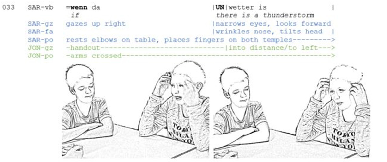
Example (1), showing children engaging in joint imagining, illustrates the internal configuration of the thinking face (speaker SAR on the right side of both stills) as well as its combination with further embodied practices. It shows that the thinking face may occur with thinking postures (ibid.) as part of a multimodal gestalt (Mondada 2014) which reflects the local demands of the activity: In Example 1, the speaker (on the right side) places the fingers on the sides of her head, which is held in a tilted position. The thinking face appears together with a wrinkled nose and narrowed eyelids that embody the process of visually focusing and 'zooming in' on an imagined scene (Heller 2021: 8).
(1) (Heller 2021: 7)

In order to make the thinking-face configuration a recognizable action (Goodwin & Goodwin, 1986: 69), it is aligned with the verbal conduct as illustrated in Example (2) for a word search: Here, speaker A begins to produce a thinking face right at the beginning of perturbations of turn production and continues it upon the marking of a repair. After finishing the gesture, A self-repairs by resuming the verb, then producing the target word and finishing the TCU.
(2) (Goodwin & Goodwin 1986: 59)
While turning away and withdrawing gaze may, in other sequential environments, be interpreted as disengaging from interaction, the usage of the thinking face within perturbations and/or pauses of ongoing turn production (Example 2) in fact indicates an intensified involvement in the word search and a continued commitment to the sequential development of the shared course of action.
Recipients attend to the producer of the thinking face and monitor their ongoing engagement in the activity. Under certain conditions, the thinking face may provide the recipient with an 'entry point' into collaborative turn-production (Lerner 1996, 2004): If the speaker looks at their partner while searching for the right word, this can be interpreted as an invitation to participate in the search, whereas looking away signals that they do not want to be interrupted. Thus, it can be the ongoing thinking face gesture or the abandoning of it – especially the (re-)turning of the gaze towards the interlocutor – that establishes opportunities for participation, e.g., by providing support with a word search (Goodwin & Goodwin 1986). If the recipient of an utterance produces a thinking face, this may be interpreted as a sign of trouble (e.g., a referential problem), leading speakers to expand their turn in order to resolve it (Stolle & Pfeiffer 2023).
The thinking face can be produced in further sequential environments: Besides word searches and initiations of other-repair in referential problems (Stolle & Pfeiffer 2023), it has also been described for activities such as argumentative decision-making in children’s interaction (Heller 2021) or storytelling (Bavelas & Chovil 2018). At the beginning of narratives, speakers might produce a prolonged thinking face (ibid.: 107–113), which signals that the speaker will keep the turn for the purpose of narrating. During argumentative decision-making among children, the main functions of the thinking face center around "creating epistemic ecologies for collaborative reasoning" (Heller 2021: 2), i.e., to (co-)imagine and "embody a hypothetical scenario", to engage in "thoughtful searching", and to do "critical thinking" about (a part of) an argument (ibid.: 5). The reciprocal use of the thinking face of both speaker and recipient is seen as an established participation framework for joint imagination.
A different but related function of the thinking face is displaying uncertainty (Goodwin, 1987), i.e., downgrading the speaker’s epistemic stance about a statement he or she is about to make. This modalizing use of the thinking face alters the frame for interpreting an utterance (Heller 2021: 3).
Descriptions of the thinking face from conversation analysis have also informed experimental studies on human–android interaction. Namba et al. (2024) implemented the combination of furrowed brows and narrowed eyelids in an android and found that it increased the recipients’ perception of thoughtfulness, authenticity, human-likeness, and appropriateness, while reducing the android’s 'eeriness'.
Additional Related Entries:
Cited References:
Andries, F., Meissl, K., de Vries, C., Feyaerts, K., Oben, B., Sambre, P., Vermeerbergen, M., & Brône, G. (2023). Multimodal stance-taking in interaction. A systematic literature review. Frontiers in Communication, 8, 1187977.
Bavelas, J., & Chovil, N. (2018). Some pragmatic functions of conversational facial gestures. Gesture, 17(1), 98–127.
Bavelas, J.; Gerwing, J., & Healing, S. (2014). Including facial gestures in gesture-speech ensembles. In M. Seyfeddinipur & M. Gullberg (Eds.), From Gesture in Conversation to Visible Action as Utterance: Essays in honor of Adam Kendon. John Benjamins, 15–34.
Catford, J. C. (1988). A practical introduction to phonetics. Oxford University Press.
Chovil, N. (2024). From the neck up. Facial gestures in dialogue. In: A. Cienki (ed.). The Cambridge Handbook of Gesture Studies. Cambridge University Press. 112-130.
Clift, R. (2021). Embodiment in dissent: The eye roll as an interactional practice. Research on Language and Social Interaction, 54(1), 1–16.
Clift, R., & Rossi, G. (2023). Speaker eyebrow raises in the transition space: Pursuing a shared understanding. Social Interaction. Video-Based Studies of Human Sociality, 6(3).
Cooperrider, K., & Nunez, R. (2012). Nose-pointing. Notes on a facial gesture in Papua New Guinea. Gesture, 12(2). 103-129.
Deppermann, A., & Schmidt, A. (2021). Micro-sequential coordination in early responses. Discourse Processes, 58(4), 372–396.
Dix, C., & Groß, A. (2023). Surprise about news or just receiving information? Moving and holding both eyebrows in co-present interaction. Social Interaction. Video-Based Studies of Human Sociality, 6(3).
Ekman, P. (1979). About brows. Emotional and conversational signals. In: M. von Cranach, et al. (Eds.): Human ethology. Claims and Limits of a New Discipline (pp. 169-249). Cambridge University Press.
Ekman, P. (1970). Universal facial expressions of emotion. Californian Mental Health Research Digest, 8(4). 151-158.
Ekman, P., & Friesen, W.V. (1969). The repertoire of nonverbal behavior. Categories, origins, usage, and coding. Semiotica, 1(1), 49–98.
Enfield, N. J. (2001). ‘Lip-pointing': A discussion of form and function with reference to data from Laos. Gesture, 1(2), 185–212.
Feyaerts, K., Rominger, C., Lackner, H. K., Brône, G., et al. (2022). In your face? Exploring multimodal response patterns involving facial responses to verbal and gestural stance-taking expression. Journal of Pragmatics, 190, 6-17.
Goodwin, M. H., & Goodwin, C. (1986). Gesture and coparticipation in the activity of searching for a word. Semiotica, 62(1-2), 51–75.
Groß, A., Dix, C., Ruusuvuori, J., & Peräkylä, A. (2023). Facial gestures in social interaction. Introduction to the special issue. Social Interaction. Video-Based Studies of Human Sociality, 6(3).
Gudmundsen, J., & Svennevig, J. (2020). Multimodal displays of understanding in vocabulary-oriented sequences. Social Interaction. Video-Based Studies of Human Sociality, 3(2).
Heath, C.; vom Lehn, D.; Cleverly, J., & Luff, P. (2012). Revealing surprise. The local ecology and the transposition of action. In A. Peräkylä & M. L. Sorjonen (Eds.), Emotion in Interaction (pp. 212–234). Oxford University Press.
Heller, V. (2021). Embodied displays of ‘doing thinking'. Epistemic and interactive functions of thinking displays in children's argumentative activities. Frontiers in Psychology, 12, 1–21.
Holler, J. (2025). Facial clues to conversational intentions. Trends in Cognitive Sciences, 29(8), 750–762.
Hömke, P., Levinson, S. C., Emmendorfer, A. K., & Holler, J. (2025). Eyebrow movements as signals of communicative problems in human face-to-face interaction. Royal Society Open Science, 12(3), 241632.
Hömke, P., Holler, J., & Levinson, S. (2017). Eye blinking as addressee feedback in face-to-face conversation. Research on Language and Social Interaction, 50(1), 54-70.
Katila, J. (2023). The experiencing face: Communicative and felt aspects of the face during kissing and hugging between romantic partners. Social Interaction. Video-Based Studies of Human Sociality, 6(3).
Kaukomaa, T., Peräkylä, A., & Ruusuvuori, J. (2014). Foreshadowing a problem: Turn-opening frowns in conversation. Journal of Pragmatics, 71, 132–147.
Kaukomaa, T., Peräkylä, A., & Ruusuvuori, J. (2013). Turn-opening smiles: Facial expression constructing emotional transition in conversation. Journal of Pragmatics, 55, 21–42.
Kääntä, L. (2014). From noticing to initiating correction: Students’ epistemic displays in instructional interaction. Journal of Pragmatics, 66, 86-105.
Kärkkäinen, E., & Thompson, S. A. (2018). Language and bodily resources: 'Response packages' in response to polar questions in English. Journal of Pragmatics 123, 220–238.
Kärkkäinen, E., & Keisanen, T. (2012). Linguistic and embodied formats of making (concrete) offers. Discourse Studies, 14(5), 587–611.
Kendon, A. (2004). Gesture: Visible action as utterance. Cambridge University Press.
Kupetz, M. (2014). Empathy displays as interactional achievements: Multimodal and sequential aspects. Journal of Pragmatics, 61(4-34).
Levinson, S. C. (2013). Action formation and ascription. In T. Stivers, & J. Sidnell (Eds.), The handbook of conversation analysis (pp. 103-130). Wiley-Blackwell.
Mondada, L. (2011). Understanding as an embodied, situated and sequential achievement in interaction. Journal of Pragmatics, 43, 542–552.
Mondada, L. (2021). How early can embodied responses be? Issues in time and sequentiality. Discourse Processes, 58(4), 397–418.
Nota, N., Trujillo, J.P., & Holler, J. (2023), Conversational eyebrow frowns facilitate question identification: An online study using virtual avatars. Cognitive Science, 47: e13392.
Nota, N.; Trujillo, J. P., & Holler, J. (2021). Facial signals and social actions in multimodal face-to-face interaction. Brain Sciences, 11, 1017.
Oloff, F. (2018). ‘Sorry?'/‘Como?'/‘Was?' – Open class and embodied repair initiators in international workplace interactions. Journal of Pragmatics, 126, 29–51.
Peräkylä, A., & Ruusuvuori, J. (2012). Facial expression and interactional regulation of emotion. In A. Peräkylä & M.-L. Sorjonen (Eds.): Emotion in Interaction (pp. 64-90). Oxford University Press.
Reis de Souza, M. (2024). Multimodal responses to questions: turn-initial oh coordinating with raised eyebrows in video-mediated interaction. Gesprächsforschung – Onlinezeitschrift zur verbalen Interaktion, 25, 54-74.
Ricci Bitti, P. (2014). Facial expression and social interaction. In C. Müller, A. Cienki, E. Fricke, S. Ladewig, D. McNeill & J. Bressem (Eds.), Body – Language – Communication. An international Handbook on Multimodality and Human Interaction (pp. 1342-1349). De Gruyter Mouton.
Ruusuvuori, J., & Peräkylä, A. (2009). Facial and verbal expressions in assessing stories and topics. Research on Language and Social Interaction, 42(4), 377–394.
Selting, M. (2017). The display and management of affectivity in climaxes of amusing stories. Journal of Pragmatics, 111(1–32).
Shor, L. (2024). Eye closures in spoken Hebrew. Conversational functions and meaning semiosis. Pragmatics.
Stolle, S. I., & Pfeiffer, M. (2023). Stand-alone facial gestures as other-initiations of repair. Social Interaction. Video-Based Studies of Human Sociality, 6(3).
Wang, X., & Li, X. (2023). Teachers’ eyebrow and head movements and repeats as other-initiations of repair in second-language classrooms. Social Interaction. Video-Based Studies of Human Sociality, 6(3).
Wiggins, S., & Keevallik, L. (2023). Transformations of disgust in interaction. The intertwinement of face, sound and the body. Social Interaction. Video-Based Studies of Human Sociality. 6(2).


